iCareManager Blog
AI Can Feel Uncomfortable and Why That Matters By Saima Khan, Chief Strategy & Compliance Officer, iCareManager
Saima Khan, Chief Strategy & Compliance Officer, explains why AI can feel uncomfortable in care settings and why that tension matters.
Januay 20 20267 min read
AI Isn’t the Hard Part. Change Is.
Change is inevitable, and it can be both exciting and uncomfortable. Artificial Intelligence (AI) amplifies this dynamic, accelerating change while making its discomfort impossible to ignore.
As we step into 2026 with AI more present on the horizon than ever before, this tension feels particularly palpable. Especially visible in healthcare tech, innovation must be carefully balanced against safety, regulation, and accountability, even as speed-to-clarity accelerates. Furthermore, AI doesn’t simply introduce new tools; it challenges leaders and staff alike to fundamentally rethink their roles, their value, and what effective leadership and contribution means.
I encountered a similar challenge early in my career while pursuing my certification as a Lean Six Sigma Blackbelt and then implementing it in organizations where the methodology was entirely new. Adopting a more disciplined, statistical approach to problem-solving required a fundamental shift in both mindset and practice. Although people were receptive to the vision of improved processes and solutions, familiar habits were difficult to abandon, which often slowed progress despite the promise of better outcomes from the new methodology.
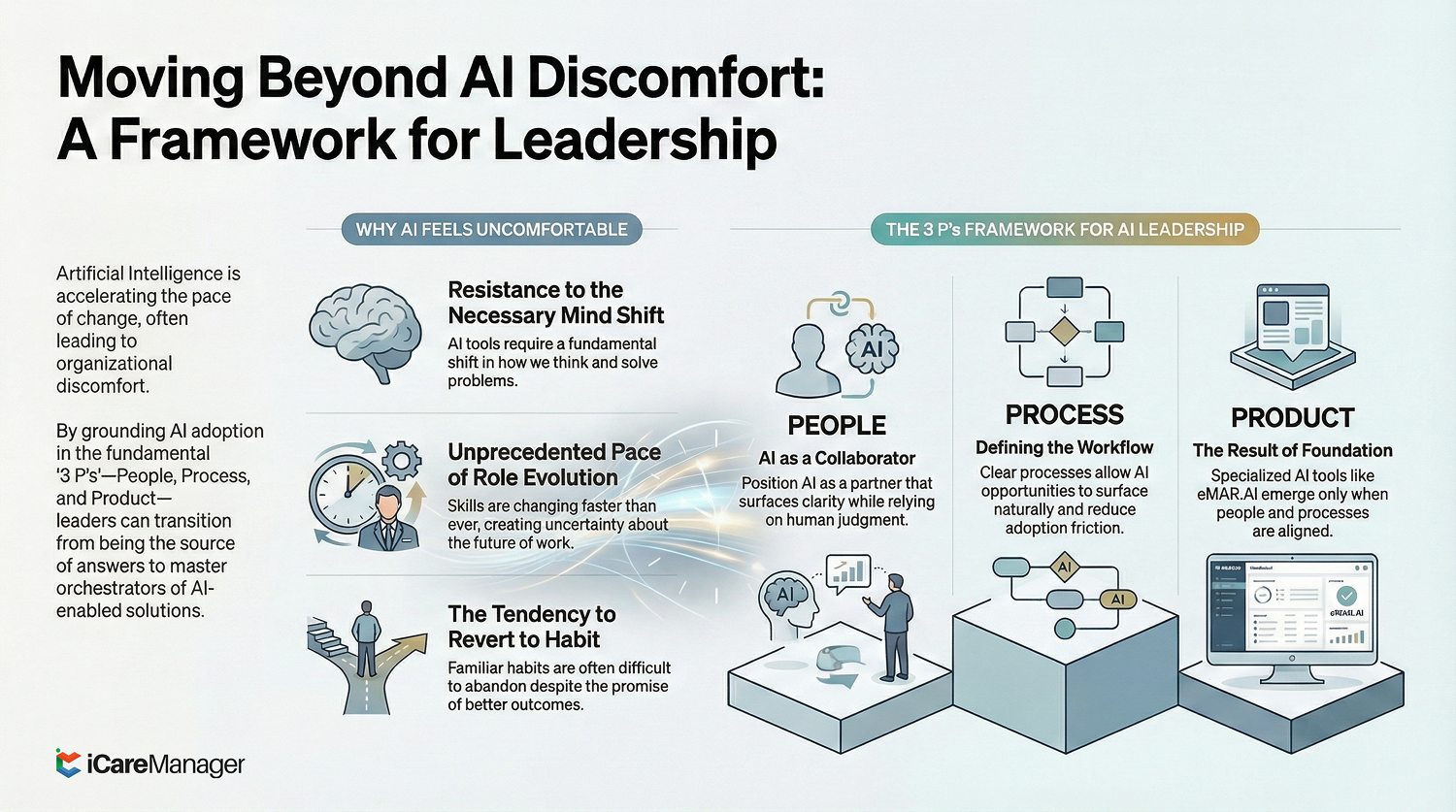
That experience shaped how I approach change in all of the roles I’ve held since then, and it’s why this moment with AI feels familiar. People may be uncomfortable with AI, not because they dislike the technology or deny its value, but for three simple reasons:
- We have a tendency to resist change: People naturally prefer the old ways of doing things.
- We don't always understand the necessary mind shift: While AI tools may seem easy to use, adopting them effectively requires a completely new way of thinking about and solving problems.
- Roles are evolving at an unprecedented pace: The speed at which job roles and required skills are changing due to AI is faster than we've ever experienced, creating significant feelings of discomfort and uncertainty about the future of work.
Notably, what’s different now is the pace and intensity of the impending changes in every industry. For some, that’s energizing. For others, it’s overwhelming and uncomfortable.
And that reaction matters, because how leaders respond to this discomfort determines whether AI becomes a source of clarity and progress or confusion and resistance.
So How Do We Lean In?
As the new year ahead takes shape, leaders are asking real, practical questions:
How do we build an “AI-first” mindset responsibly?
Where does meaningful adoption actually begin?
In my experience, the answer isn’t always to start with tools, platforms, or use cases. Sometimes, we need to step back to an even simpler, more structured way of thinking, grounding new capabilities in a framework people already understand and trust.
That’s exactly how we’re approaching AI at iCareManager.
Keeping AI Grounded in the 3 P’s
Clear vision without a framework for execution quickly becomes a risk, especially when adopting new technology like AI.
This belief guides how I lead strategy, execution, and compliance at iCareManager. Our early investment in foundational frameworks like SOC 2, and the achievement of both Type I and Type II certifications last year, reflected that commitment - reinforcing confidence in our operations through clear processes and controls.
The same holds true for AI. Without clear direction, established processes, and a shared operational framework, powerful AI tools may fail to improve impactful outcomes, inadvertently amplifying confusion and risk instead.
That’s why before adopting or building AI, we return to the 3 P’s as fundamentals to carry forward into this new era of AI: people, process, and product.
People Matter First
The core drivers of organizational change and success are people, both customers and employees. Therefore, all future endeavors, including process and product development, must be built upon a foundation of clear communication, shared knowledge, and sound decision-making.
While AI challenges traditional notions of expertise and leadership, when it is positioned as a collaborator rather than a replacement, resistance softens and confidence grows. At iCareManger, we see AI as a highly capable partner. It accelerates thinking and surfaces clarity, while still relying on human judgment to set direction, define constraints, and make final decisions.
The essence of leadership is shifting as AI handles more analytical and repetitive tasks. It’s becoming more clear that the most effective leaders will transition from being the source of every answer to becoming master orchestrators of better solutions. This involves defining the right limitations, posing more insightful questions, and directing teams toward stronger outcomes and results, which will be increasingly enabled by AI.
Process Clarity Drives AI Adoption
A successful, effective, and non-disruptive adoption of AI solutions fundamentally depends on a base of clear processes, well-defined workflows, and consistent, repeatable execution.
When workflows, decision points, and ownership are well-defined, opportunities for AI surface naturally and adoption becomes easier. When they aren’t, AI introduces more questions than answers.
For iCareManager, AI is playing a powerful role in improving clarity early in our product lifecycle. Translating complex, sometimes ambiguous customer requirements into structured documentation allows teams to align sooner, reduce rework, and shorten feedback loops. This efficiency translates directly into faster and higher quality deployment of valuable features to our users.
Product Reflects the Outcome
A product is the visible result of how well people and process come together. When strong foundations allow teams to focus on thoughtful design and customer-focused solutions, products become reliable, scalable, and trusted, especially in complex, regulated environments like healthcare.
For iCareManager, our people and process focus has led to even more meaningful product innovation such as emar.ai and casemanagement.ai. These specialized solutions are specifically engineered to boost efficiency and outcomes even more, without compromising accountability or the vital human element in our customer’s care delivery.
This is how we continue to build trust with technology, while leveraging and delivering AI solutions.
Leading Change with Intention
At iCareManager, we view AI as an extension of human capability, a way to strengthen thinking, sharpen decision-making, and improve execution.
AI is not replacing critical thinking, but elevating it.
AI doesn’t remove judgment, but reinforces it.
From Lean Six Sigma to SOC 2 to AI, the lesson has been consistent: adopting new tools without grounding them in simple fundamentals and a structured approach can heighten uncertainty and discomfort.
So what we carry forward into this new era of AI is simple: people, process, and product. By anchoring AI through this lens, we make change easier to understand, adopt, and sustain, leading to far more practical and powerful applications and use of AI.
It’s how we are moving beyond the discomfort of AI and instead leading with it. The AI-Powered Employee: Threat or Opportunity? Redefining Human Work
Download the AI in Healthcare Guide
See how iCareManager works in practice
Book a Demo